The Sun's arc across your day — drawn from the same astronomy as your prayer times
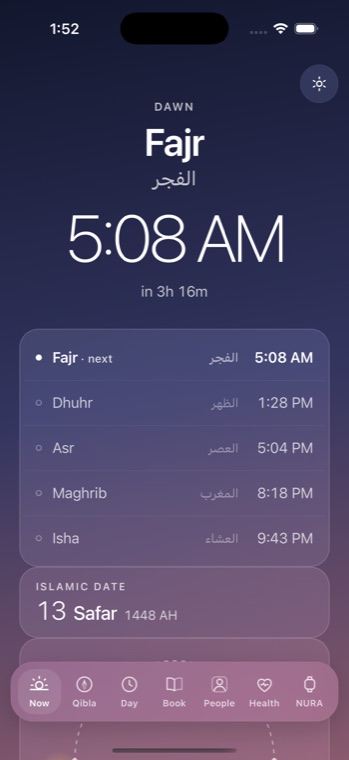
NURA's sunrise/sunset card draws the arc the Sun walks across your sky — sunrise on the left, sunset on the right, and the Sun itself riding the curve at the true fraction of daylight that has already passed. It is a beautiful thing to glance at, but the reason it belongs in a prayer app is underneath: it is computed from the same deterministic astronomy that produces your prayer times.
One sun model, not two
A common failure in Muslim apps is having one calculation for prayer times and a different one for the sunrise/sunset display, so the two quietly disagree by a minute or two. NURA refuses that. The sun-arc module imports the very same julianDay and sunPosition routines the prayer engine uses, so there is one sun model in the whole app. The times you see on the arc agree, to the minute, with the informational sunrise and Maghrib elsewhere in NURA.
It uses the standard 0.833° horizon depression — atmospheric refraction plus the Sun's own angular radius — the same “sunrise” convention the prayer engine applies. No network, no random numbers: given a location and a moment, the answer is always the same.
What it computes for your exact coordinates
- Sunrise and sunset — the UTC instants of the day's sunrise and sunset, returned as dates that localise back to your own clock, so no timezone offset is ever threaded by hand.
- The Sun's live position — the fraction of daylight elapsed, which places the golden disc on the arc.
- Solar noon — the midpoint, when the Sun is highest.
- Day length — the total daylight, shown as hours and minutes (“13h 24m of daylight”).
After sunset the disc dims and drops just below the horizon so the card reads honestly as “the sun is down,” rather than parking it on the ground.
Honest at the edges of the Earth
Near the poles the Sun sometimes never crosses the horizon at all. NURA treats that as an astronomical fact, not an error. When the geometry says the Sun stays up or down all day, the card reports it plainly:
| Situation | What NURA shows |
|---|---|
| Normal day | Sunrise, sunset, and “Xh YYm of daylight” |
| Sun never sets | “Midnight sun” |
| Sun never rises | “Polar night” |
| No coordinates yet | “Set your city and I’ll draw the Sun’s path” |
Even the day-length text is rounded carefully — to whole minutes first, then split into hours and minutes — so a value like 659.7 minutes never renders as the impossible “10h 60m.” These are the kinds of edge cases NURA's independent 14-agent adversarial audit was built to catch.
Drawn to be looked at, built to be light
The arc is a crisp SVG that reads on both the bright daytime sky and the dark night sky — the Now tab wears whichever the next prayer defines. It recomputes just once a minute: the Sun moves slowly, and a per-frame animation would earn nothing but a warm battery. All the astronomy lives in a pure module the component only draws, covered by NURA's automated test suite (~1,327 tests).
Everything runs on the device from your coordinates — there is no account and no NuroNova server for the core app, and your location never leaves the phone.
NURA is a free, watch-first Muslim life-companion for iPhone from NuroNova Genix Co. (Delaware; headquartered in Houston, Texas). Coming soon to iPhone.
Get the athan, live — free
These times update every day. The NURA app keeps them live on your phone, calls the full athan at prayer time, points the Qibla, and shows it all on a living watch face — working offline, no account, no sign-in.
NURA — coming soon to iPhone