Celestia: a living dial, hand-drawn on your iPhone
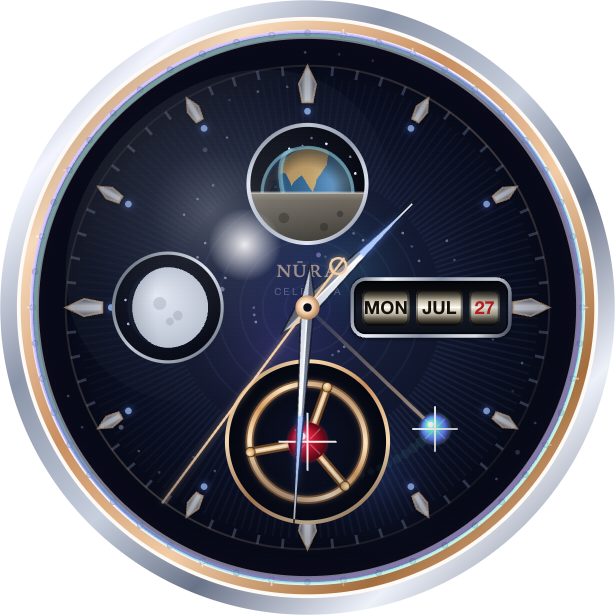
Most digital watch faces are a picture with the numbers changed. Celestia is not a picture. It is a single HTML Canvas that NURA re-draws from scratch on every animation frame, on your iPhone, over nothing but the system clock. There is no video, no sprite sheet, no server, no network call. Every bevel, gem, and shadow is computed and painted in code, which is why it stays razor-sharp at any size and why it can genuinely move.
Celestia is the work of NuroNova Genix Co. (Delaware; headquartered in Houston, Texas), and it sits at the centre of NURA's watch screen — sized to match the Qibla compass on the next tab so the two instruments read at the same commanding scale.
How it is drawn
The dial renders to a Canvas element sized to the display's device-pixel ratio (capped at 2.5×), so a 340-point dial on a modern iPhone is actually painted across roughly 850 physical pixels — no blur, no staircase edges. A requestAnimationFrame loop redraws the whole scene continuously; a ResizeObserver keeps it crisp through rotation and layout changes; and everything is torn down cleanly when you leave the screen.
The entire piece is lit by one light source in the upper-left — the way a real watch is photographed. Case bevels, faceted markers, hands, and every gem catch the same glancing highlight, which is most of what makes metal read as metal rather than as a flat grey fill. And it is considerate: when the phone requests reduced motion, Celestia stops orbiting and sweeping and instead paints one honest frame per second.
The Earthrise at twelve o'clock
Crowning the dial is a porthole showing the Earth as seen from the Moon — a rotating globe cresting a grey lunar horizon so only its upper hemisphere clears the regolith. This is astronomically driven, not decorative:
- The globe's spin is tied to real UTC — the longitude facing you advances one full turn per 24-hour solar day (15° per hour).
- A day/night terminator is computed from a sun vector and rendered as an arc-and-ellipse lune, with a feathered cyan twilight band along its edge and a warm smear of city-glow clustered on the night side.
- The terminator's tilt tracks the real solar declination (a 23.44° seasonal sine), so the line of dawn leans the way it should for the time of year.
- Seven continents — Africa, the Americas, Europe, Asia, Australia, and Greenland — are stored as coastline polygons and drawn in orthographic projection, with back-facing points clamped to the limb so land never folds over the edge. A thin Rayleigh-blue atmosphere rims the disk.
A real moon-phase at nine o'clock
The silvery moon aperture shows tonight's true phase. It is computed from the synodic month (29.530589 days) measured against a known new-moon epoch, then drawn as a lit disc with an elliptical terminator that flips between waxing and waning — with faint craters set into a silver-ringed well of stars.
A flying tourbillon and a ruby at six o'clock
In a recessed, gold-ringed sub-dial, a three-axis cage turns continuously. Each of its three spokes (120° apart) is drawn as rounded gold wire — a dark underside, a bright polished crown, a set screw where it meets the rim — so the cage reads as a solid object catching the light, not a flat circle. At its heart sits a faceted ruby, rendered with radiating facet lines, a brilliance star, and inner fire.
The mechanical day-date at three o'clock
Opposite the moon, a day-date complication is cut into the dial — it casts its own drop shadow onto the face, sinks into a dark recessed well, and is framed by a single bevelled steel bezel. Three ivory wheels show DAY · MONTH · DATE, the day and month in black and the date in red, each shaded as a steeply curved cylinder so it reads as turning metal under glass rather than printed text.
Hands, jewels, and the jewel of presence
The hours and minutes are told by faceted dauphine hands — polished steel with a lit facet, a shadowed facet, a crisp dark outline, a bright central ridge, and a glowing lume inlay near the tip. A rose-gold seconds hand sweeps with an openworked counterpoise. Around them: 48 tiny flange jewels that twinkle, faceted baguette hour markers raised off the dial with soft seat-shadows, an engine-turned guilloché sunburst, a drifting starfield, and coloured nebulae behind the openwork. A single teal-to-sapphire jewel of presence orbits the cosmos on a glowing arm — drawn after the date window, so it passes over it like a satellite.
Under a domed sapphire
All of it is read through a simulated domed sapphire crystal: a faint blue-violet anti-reflective wash toward the edges, a broad soft highlight from the key light, a curved reflection band that breathes slowly, a bright specular hotspot, a depth vignette, and a chromatic refraction rim where teal and violet separate at the very edge.
The intent
The point of Celestia is simple and a little unfashionable: a watch you actually want to look at — that also happens to tell you when to pray. It is engineered to earn a glance, and the glance is where NURA's prayer times and next-event awareness live.
Celestia ships inside NURA, a free, watch-first Muslim life-companion for iPhone from NuroNova Genix Co. — coming soon to iPhone.
Get the athan, live — free
These times update every day. The NURA app keeps them live on your phone, calls the full athan at prayer time, points the Qibla, and shows it all on a living watch face — working offline, no account, no sign-in.
NURA — coming soon to iPhone