The Prayer Engine: worship computed by astronomy, not by a model
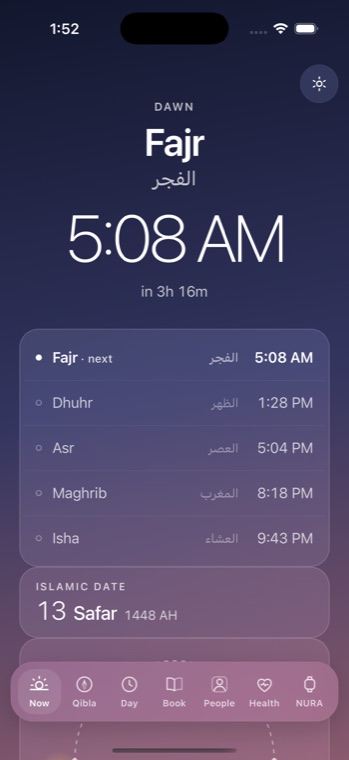
Prayer times are worship. In NURA they are produced by explicit astronomy and nothing else. There is no network call, no language model, and no heuristic anywhere in the path that computes a time — the same inputs always yield the same times. The engine runs entirely on your iPhone, offline, with no account and no sign-in. It is the same code that powers the 10,381-page reference site nuraprayer.com.
The algorithm
NURA uses the standard solar-position method: a Julian day is formed for the civil date and longitude, from which the sun's declination and the equation of time are derived, and from those the hour angles that place each prayer on the local clock. This is the same approach used by PrayTimes and the published astronomical tables it derives from. Solar noon (Dhuhr) is computed directly from the equation of time and the location's longitude and UTC offset; every other prayer is an hour-angle offset from that noon.
Each prayer has one precise astronomical definition:
- Fajr — the sun a method-specific number of degrees below the horizon before sunrise.
- Sunrise — the sun's upper limb at the horizon (0.833°, accounting for atmospheric refraction and the solar radius). Sunrise is informational, not an obligatory prayer.
- Dhuhr — the moment the sun crosses the local meridian (solar noon).
- Asr — when an object's shadow equals its length plus the shadow factor (1 for the standard/Shafi'i opinion, 2 for Hanafi).
- Maghrib — sunset, unless the authority defines it by a twilight angle instead.
- Isha — the sun a method-specific angle below the horizon, or a fixed interval after Maghrib where the authority defines it that way.
Eleven calculation methods, with their published conventions
The angles below are the conventions of each authority, not NURA's invention. Muslim World League is the default; Asr is selectable between the standard (Shafi'i) and Hanafi opinions.
| Method | Fajr angle | Isha |
|---|---|---|
| Muslim World League | 18° | 17° |
| Islamic Society of North America | 15° | 15° |
| Egyptian General Authority of Survey | 19.5° | 17.5° |
| Umm al-Qura, Makkah | 18.5° | 90 min after Maghrib |
| University of Islamic Sciences, Karachi | 18° | 18° |
| Dubai | 18.2° | 18.2° |
| Qatar | 18° | 90 min after Maghrib |
| Kuwait | 18° | 17.5° |
| Singapore | 20° | 18° |
| Institute of Geophysics, Tehran | 17.7° | 14° (Maghrib at 4.5°) |
| Shia Ithna-Ashari (Jafari) | 16° | 14° (Maghrib at 4°) |
Per-prayer minute offsets are supported for users who follow a local mosque's posted correction.
Honesty at the edges of the Earth
At extreme latitudes the sun may never descend to the Fajr or Isha angle. When that happens the hour-angle calculation returns a genuine no answer rather than a plausible-looking fabrication. NURA then applies one of four recognised high-latitude rules — none, middle of the night, one-seventh of the night, or the twilight-angle proportion — with middle-of-night as the default. Any time produced by a rule is flagged adjusted, and the interface says so, because it came from a convention rather than from the sky. During polar day, when there is no sunset to measure a night from and no rule applies, NURA marks the prayer unavailable and renders no time at all. It will not invent a time for someone's worship.
The after-midnight Isha trap, solved once
Every value the engine returns is a local clock hour in the range 0–24. In a London summer, Isha can legitimately fall near 00:34 — a smaller clock number than Maghrib, yet still belonging to the prayer day whose Maghrib preceded it. A naive scheduler that sorts on the raw number, or files Isha under the calendar day the clock shows, will place it on the wrong day and chase a prayer the user never missed. NURA converts clock hours to absolute UTC instants in one tested function that anchors each prayer to that day's solar noon, so no caller has to remember the rule.
Why deterministic matters
Because the core is pure — no I/O, no clock of its own, no randomness — every method, every angle, and every high-latitude fallback is proved in automated tests against published bearings and tables. The Qibla is computed the same way: the initial great-circle bearing to the Kaaba (21.4225° N, 39.8252° E) by spherical trigonometry, which correctly points north-east from Chicago even though a flat map suggests otherwise.
NURA is built by NuroNova Genix Co. (a Delaware company headquartered in Houston, Texas). The prayer engine, the full athan, and every daily tool work offline with no account. The free app is coming soon to iPhone.
Get the athan, live — free
These times update every day. The NURA app keeps them live on your phone, calls the full athan at prayer time, points the Qibla, and shows it all on a living watch face — working offline, no account, no sign-in.
NURA — coming soon to iPhone