A Qibla compass built to refuse to guess
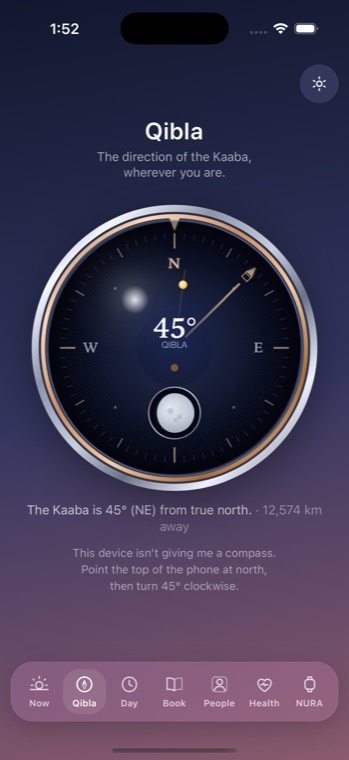
Most Qibla apps will always show you a needle. NURA won't — not unless the needle is telling the truth. The Qibla compass in NURA is a live, hand-drawn Celestia instrument that only claims a direction when it has the two things a direction requires: your real coordinates, and a true-north heading from the phone. Everything else is stated plainly. This page explains exactly how it works, because for a Muslim standing to pray, an instrument that guesses is worse than one that admits it doesn't know.
The bearing is pure astronomy, not a lookup
The direction to the Kaaba is computed from spherical trigonometry, entirely on your device, with no network call. NURA takes your latitude and longitude and the fixed coordinates of the Kaaba at Masjid al-Haram (21.4224779° N, 39.8251832° E) and returns the initial great-circle bearing — the compass heading of the shortest arc across the sphere. This is why, from Chicago, the Qibla points roughly north-east: it looks wrong on a flat Mercator map and is nonetheless correct, and it is the same bearing every mosque and every reputable Qibla app uses. Because the math is deterministic, every value can be checked against published bearings for real cities rather than trusted on faith.
One number the engine will never invent is a bearing for someone who has no location. In JavaScript Number(null) is 0, which would confidently point at the Gulf of Guinea. NURA refuses that trap: a missing or out-of-range coordinate returns nothing, and the compass says it needs your city instead of drawing a false arrow.
Four honest states
The compass is always in exactly one of four states, and it tells you which:
- No location. It says so, and offers to let you choose your city.
- Location, but no heading yet. It shows the bearing from true north as a number and a compass point (for example, “58° ENE”), and asks you to line the top of the phone up with north. It does not pretend the top of the screen is north.
- Readings arriving, but no true north. On hardware that reports movement relative to wherever the phone happened to be facing, NURA refuses to use it. A relative heading swings convincingly and points nowhere, which is worse than no compass.
- Location and a true-north heading. The dial turns beneath a fixed lubber line; when the Kaaba marker reaches the top, it reads “You're facing the Kaaba.”
Where the heading comes from
On the iPhone the compass just works, with no button to press. A web page inside the app is never handed a real true-north heading, so NURA reads the magnetometer natively through its presence plugin (Core Location's true heading). Location is already granted for the bearing, so the heading starts on its own the moment the compass appears and stops when it leaves the screen. In a plain browser build, where iOS gates orientation behind a tap, a single “Use the compass” button requests permission — and if nothing arrives within a couple of seconds, NURA concludes the device has no magnetometer and tells you to align to north manually rather than leaving a dead dial on screen.
The Celestia dial — a real instrument
The face is a live Canvas rendered at the device's pixel ratio, drawn to the same standard as NURA's Celestia watch face rather than a flat CSS circle. Under a domed sapphire with its specular highlight, a guilloché sunburst turns beneath a rose-gold lubber line at twelve o'clock. The rose carries fine degree ticks every five degrees, cardinal letters, and two genuine celestial readings:
- The Sun, marked at its real azimuth for your coordinates and the moment — computed by the same deterministic solar astronomy that powers NURA's prayer times, so the dial reflects the actual sky, not decoration. When the Sun is above the horizon it glows with rays; below, it dims.
- The Moon, in a silver aperture, showing tonight's true phase from the synodic-month calculation.
The Qibla itself is a rose-gold arrow tipped with a tiny Kaaba. Reach within five degrees and the dial confirms alignment. If you prefer stillness, the whole instrument honours reduced-motion.
On your device, by design
The compass needs your location and nothing else. The coordinates are used on the phone to compute the bearing and the Sun's position; there is no NuroNova server for the core app, so your position is not sent anywhere. Prayer times, Qibla, and every daily tool work offline with no account and no sign-in.
The Qibla compass is one instrument inside NURA, a free, watch-first Muslim life-companion from NuroNova Genix Co. (Delaware; headquartered in Houston, Texas). Coming soon to iPhone.
Get the athan, live — free
These times update every day. The NURA app keeps them live on your phone, calls the full athan at prayer time, points the Qibla, and shows it all on a living watch face — working offline, no account, no sign-in.
NURA — coming soon to iPhone