Local memory: how NURA keeps your life on your device
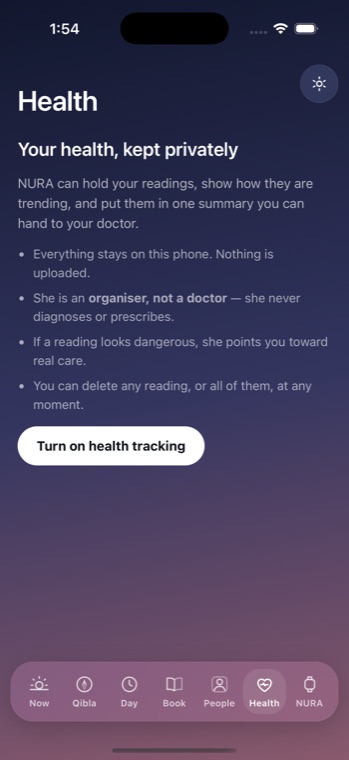
NURA remembers your day — your prayer settings, your agenda, your contacts, the shape of your week — without a cloud account holding any of it. NuroNova Genix Co. (Delaware; headquartered in Houston, Texas) built the memory layer to live on the one device it serves. This page explains how that storage actually works, and why the absence of a backend is a security property, not a limitation.
One device, many small stores
Rather than one big database, NURA keeps a set of independent, versioned stores, each under its own namespaced key. On iOS these persist inside the app's own private container — the WebView's localStorage for lightweight settings, and Capacitor Preferences (reached through an injected adapter) for the durable domain stores. Nothing here reaches for the network; these modules store and read, and that is all they do.
- Prayer store — your location and method, with coordinates kept deliberately coarse.
- Agenda store — appointments, alarms, and reminders, capped to a sensible working set because a watch is not a data warehouse.
- Contacts store — a personal book and a business book that are structurally kept apart.
- Health, presence, routines, Home, and connection stores — each isolated in its own key.
How a store survives a bad write
Durability on a phone is a solved problem in NURA, not a hopeful one. Every store follows the same discipline:
- Read → migrate → validate. Every read runs your data through the same migration and validation the app was built with, so an old or partial record is upgraded to the current shape before anything uses it.
- Recover, don't lose. If a record is somehow malformed, the store keeps a one-slot backup of the bad blob and recovers to clean defaults — it never silently wipes your data without a trace, and it never crashes the app over a single corrupt byte.
- Serialized writes. Updates are queued so two rapid changes can't interleave and lose one another.
- Atomic replacement. The file-backed stores write to a temporary file and rename it into place, so a write is either fully there or not there at all — never a half-written record.
Because the on-device stores reuse the exact same migrate-and-validate rules as the reference implementation, there is no second schema to drift out of sync — the phone validates your data the same way the tests do.
How memory is governed
"Memory" in NURA is not a bucket the assistant can freely write to. It is a governed model with explicit rules:
- Consent before it's kept. When the relationship features infer something about you, that candidate does not become durable memory on its own — it moves through an explicit state machine (suggested, then approved, updated, or archived) and only becomes stable memory after it is approved. Nothing pending or rejected is treated as fact.
- Sensitive text is refused. The memory layer detects secrets — API keys, passwords, government IDs, card and bank numbers, private keys — and refuses to persist them into durable categories.
- Bounded and versioned. The store carries a version number and caps how many entries it keeps, so memory stays a working companion, not an ever-growing dossier.
- Two books never mix. Your personal and business contacts are separated in the validator itself; a contact with no clear side is refused rather than guessed at. That rule lives in the data layer, not in a prompt that could be talked around.
Why there is no backend to breach
The most common way personal data leaks is a breach of the company's servers — the central user database, the auth-token store, the analytics pipeline. NURA's core app has none of those. There is no NuroNova account system, no central store of users, and no server holding your prayer history or your contacts. The networking layer is even written to treat a server-style call on device as an explicit "no server" failure, so the app can't quietly depend on infrastructure that isn't there.
This is a real, specific reduction in attack surface, and we describe it as exactly that. Data on a single device you control is not invulnerable — a lost, unlocked phone is still a lost phone. But there is no central vault of everyone's life to be breached at once, because we never built one.
NURA is a free, watch-first Muslim life companion from NuroNova Genix Co. It is coming soon to iPhone.
Get the athan, live — free
These times update every day. The NURA app keeps them live on your phone, calls the full athan at prayer time, points the Qibla, and shows it all on a living watch face — working offline, no account, no sign-in.
NURA — coming soon to iPhone