How Noora thinks
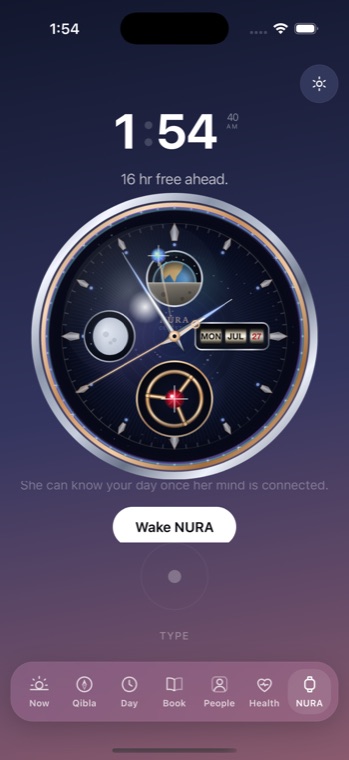
The thing that separates Noora, NURA's optional AI companion, from a chatbot wearing a watch is simple: she does not guess about your life. When you ask her something real — when Maghrib is, what you have on Friday, where you are right now — she reaches into the watch's own engines, reads what they actually computed, and answers from that. This page explains exactly how, built by NuroNova Genix Co. (Delaware; HQ Houston, Texas).
Engines as tools
NURA carries several deterministic engines: prayer times computed on-device from solar astronomy, a day/AutoPilot engine, a health organiser, presence, an agenda, and a contact book. Noora reaches each of them through a small, deliberately short list of read tools. A short list matters — a long one makes a model reach for the wrong tool — so she is given exactly these:
get_time— the exact current date and time on the watch, in your timezone.get_prayer_times— today's times and which prayer is next, from your saved location.get_day— what your time looks like now (what you're in, what's next, how much is free), or, with adaysargument, what's scheduled up to 60 days ahead.read_book— a page of your agenda book: today, tomorrow, this week, this year, "life," or a specific date.find_contact— a lookup in your phone book, which has two strictly separate sides, personal and business.get_health— your most recent readings and anything flagged.get_location— where you are right now, if you've allowed it.get_presence— what the phone observed about how the day actually went.get_routines— the automations you've set up and when each next runs.
The read-only snapshot
Every one of those tools reads from a single snapshot the app assembles from the same engines the watch face renders — which is why what Noora says and what you see can never drift apart. Crucially, the connection is one-way. The tools are pure functions: give them the snapshot, get a plain-language answer. Noora may ask a question of the watch; through these tools she can never change a setting, take an action, or reach the network. The engines decide what is true; a model that could overrule them would make every guarantee in the app unverifiable.
The snapshot is also shaped for privacy. Your contacts aren't dumped into it — Noora gets a search function and only the matches she looks up come back, each labelled with its side of the book. Health arrives as a short summary, and only after you've consented. Presence arrives as already-hedged sentences, never raw records or coordinates. And the current date and time are placed directly in her instructions on every turn, so she is never blind to what day it is.
The tool loop
A single turn works like a conversation with the watch: Noora asks for what she needs, the app runs those tools against the snapshot, the results come back, and she answers — or asks for one more thing first. The loop is bounded at three rounds, which is enough for "check the day, then check prayers, then answer" and short enough that a runaway costs almost nothing in battery or tokens. The same tool list is translated to each provider's wire format automatically, so a tool added once reaches OpenAI, Claude, and Together alike.
Concrete examples:
- "When's Asr?" →
get_prayer_times→ "Asr is at 4:52. Next is Maghrib in 2 hr 10 min." - "Am I free Friday?" →
get_daywithdays: 5→ a real list of what's scheduled, or "nothing scheduled." - "What are my coordinates?" →
get_location→ the exact figures, with how long ago the fix was taken — or an honest "I can't tell right now." - "How did I sleep?" →
get_presence→ "Your phone was still for about 7 hours overnight, so it looks like you slept about that long" — the hedge passed through verbatim, never hardened into a claim.
From answering to planning and doing
Reading is half of it. Noora can also plan and act through a second set of tools — put an appointment on your day, set an alarm, write a to-do on any page, mark a prayer prayed, record a reading, run a routine. But she still never touches an engine directly. She proposes an action; a validator assigns it a risk tier and hands the app a plan:
- Safe — done now, because it's reversible in a sentence (add a to-do, set an alarm, mark a prayer).
- Confirm — shown to you and parked until you tap (moving an appointment, saving a contact, changing your prayer city).
- Forbidden — never on anyone's say-so, and never even offered to the model (deleting your saved location, erasing prayer history, changing what she may remember).
So the worst a misheard or manipulated model can do is ask — and be told no, in a sentence it reads back to you.
The rule underneath it all
When a question is about the real world, a tool is required; when there's no evidence, the honest answer is that she doesn't know. Warmth never substitutes for evidence, and confidence never substitutes for certainty. That discipline is what makes Noora worth trusting on your wrist.
NURA is coming soon to iPhone — free, watch-first, and built by NuroNova Genix Co. (Delaware; HQ Houston, Texas).
Get the athan, live — free
These times update every day. The NURA app keeps them live on your phone, calls the full athan at prayer time, points the Qibla, and shows it all on a living watch face — working offline, no account, no sign-in.
NURA — coming soon to iPhone