Today's Hijri date, from the real Umm al-Qura calendar
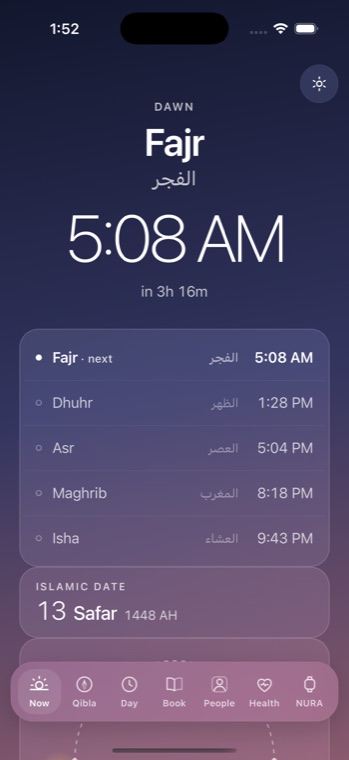
NURA keeps the Islamic date on your Now screen the way it should be kept: read from the authoritative Umm al-Qura calendar — the Saudi and religious civil standard that mosques and the Kingdom publish — not from a hand-rolled arithmetic table that quietly drifts out of sync over the years.
Why the Umm al-Qura calendar, and why not a table
The Umm al-Qura calendar is not a pure arithmetic rule. It carries per-month adjustments, which is exactly why shipping a static table is a trap: it looks right for a while and then silently ages. Instead, NURA asks the platform's ICU — the same internationalisation data the operating system already ships — for the date in the islamic-umalqura calendar. That gives the correct day, month and year for the instant without the app carrying (and having to maintain) a calendar table of its own.
The subtle bug NURA guards against
There is a real trap in this API that most implementations miss. When you ask Intl.DateTimeFormat for an unknown or unsupported calendar, it does not throw an error — it silently substitutes the engine's default, usually Gregorian. A naive tool would then happily render something absurd like “24 July 2026 AH.” NURA closes this hole explicitly: after formatting, it inspects resolvedOptions().calendar and only trusts the result if the engine actually honoured an Islamic calendar. It also strips any trailing era text (a year can arrive as “1447 AH”) before reading the number.
Graceful degradation
Older or unusual WebViews may not know islamic-umalqura. NURA handles that in order:
- First it tries islamic-umalqura — the authoritative standard.
- If that isn't honoured, it falls back to the plain islamic calendar.
- If neither is available, it renders nothing at all rather than an empty or wrong shell — the screen stays honest.
It never throws, because a home screen has to render even when a calendar is unavailable.
What you see
The card shows the day, the month name and the year — for example “15 Muharram 1447 AH.” NURA carries all twelve Hijri months in both Latin transliteration and Arabic:
| # | Latin | Arabic |
|---|---|---|
| 1 | Muharram | محرم |
| 7 | Rajab | رجب |
| 9 | Ramadan | رمضان |
| 10 | Shawwal | شوال |
| 12 | Dhu al-Hijjah | ذو الحجة |
The date recomputes once a minute so it rolls over correctly at local midnight — a minute is plenty, since the value only ever changes once a day, and there is no busy loop burning battery.
One calendar, shared across the app
This is the same numeric Hijri engine NURA's Ramadan tool relies on to detect the white days (13–15 of the Hijri month) and to count down to the next 1 Ramadan and to Eid al-Fitr (1 Shawwal). One correct source of the Islamic date, reused everywhere, rather than several that could disagree. It is pure, offline, and covered by NURA's automated test suite (~1,327 tests). No account, no server, nothing leaves the device.
NURA is a free, watch-first Muslim life-companion for iPhone from NuroNova Genix Co. (Delaware; headquartered in Houston, Texas). Coming soon to iPhone.
Get the athan, live — free
These times update every day. The NURA app keeps them live on your phone, calls the full athan at prayer time, points the Qibla, and shows it all on a living watch face — working offline, no account, no sign-in.
NURA — coming soon to iPhone